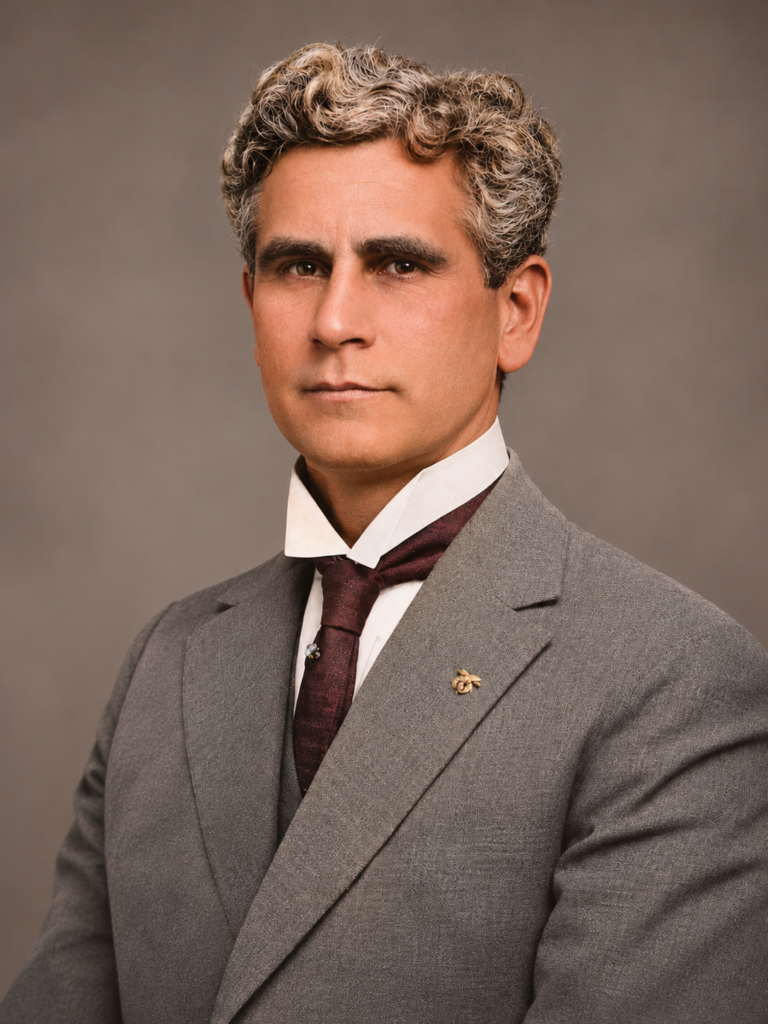
His portrait hangs on our wall, yet most members cannot tell you who he is or anything about him. Unfortunately, this is the ‘tribal culture stories’ we lose over time. Brother Jeremy D. Hogan and myself have worked hard to capture some of the information about the men whose pictures adorn our walls. This is a labor of love, history, and fraternal respect.
Long before Lubbock grew into the Hub City of the South Plains, a small circle of civic leaders, jurists, and Freemasons laid the institutional foundations of the region. Among the most notable figures from that formative era was Thomas M. “T. M.” Bartley (c. 1868–1952)—an attorney, county judge, state legislator, and one of the most influential Masonic administrators in Texas history.
South Plains Roots: Lubbock and Lynn County.
Born and raised in Ladonia, Texas, Bartley relocated to the South Plains around the turn of the 20th century, arriving at a time when vast stretches of West Texas were just beginning to organize into formal counties and municipalities.
When Lynn County—located immediately south of Lubbock—was formally organized on April 15, 1903, Bartley was tapped to serve as its very first County Judge while maintaining a law practice in Tahoka. His civic leadership soon extended to the state capitol; he represented the South Plains district in the 33rd Texas Legislature (1913–1915) and later campaigned in the 1914 Democratic primary for Commissioner of the Texas General Land Office.
During those early years on the Plains, Lubbock served as the regional center for fraternal life before neighboring towns established their own charters. Bartley actively affiliated with Masonic bodies in Lubbock, appearing alongside J. B. Bartley on the 1904 membership rolls of the Lubbock Chapter of the Order of the Eastern Star. Even after his career took him elsewhere in Texas, he remained a familiar face in Lubbock, returning regularly for regional York Rite convocations and Knights Templar conclaves.
Three Decades of Statewide Masonic Leadership
In 1913, Bartley answered the call to full-time Masonic service, relocating to Waco—then the administrative hub of Texas Masonry—where he served in top leadership roles for more than thirty years until his retirement in 1945:
- Grand Royal Arch Chapter of Texas: Served as Grand Secretary from 1913 to 1945, an extraordinary 32-year tenure.
- Grand Council of Royal & Select Masters of Texas: Served concurrently for decades as Grand Recorder.
- Grand Commandery of Knights Templar of Texas: Served as Grand Recorder and earned the distinguished honor of Right Eminent Past Grand Commander.
Legacy
Following his retirement, Bartley remained in Waco with his wife, Una, continuing to be regarded across the state as an authority on Texas Masonic history and jurisprudence. He passed away in Waco on March 5, 1952, at the age of 83. His passing was mourned not only by the Grand Commandery of Texas, but also across the South Plains, where newspapers such as the Lubbock Morning Avalanche memorialized him as one of the region’s true early pioneers.
During those early years on the Plains, Lubbock served as the regional hub for fraternal life before neighboring towns established their own charters. Bartley actively affiliated with Masonic bodies in Lubbock, appearing alongside J. B. Bartley on the 1904 membership rolls of the Lubbock Chapter of the Order of the Eastern Star. He also maintained his Knights Templar membership in Lubbock Commandery No. 60—a tie he carried throughout his statewide career, officially representing Lubbock No. 60 when he served as Right Eminent Grand Commander of the Grand Commandery of Knights Templar of Texas in 1932. Even after his work took him to Central Texas, he remained a familiar face in the Hub City, returning regularly for regional York Rite convocations and Knights Templar conclaves.
Sources & Further Reading
- Grand Commandery of Knights Templar of Texas: Past Grand Commanders (Thomas Mitchell Bartley, Lubbock No. 60, 1932)
- Grand Royal Arch Chapter of Texas: Past Grand High Priests (Thomas Mitchell Bartley, Honorary, 1941)
- Grand Council of Royal & Select Masters of Texas: Past Grand Masters (Thomas Mitchell Bartley, Honorary, 1941)
- Grand Chapter of Texas, Order of the Eastern Star: 1904 Annual Proceedings (Lubbock Chapter Membership Rolls, PDF)
- Fannin County Historical Commission: History of Bethel Lodge No. 134, Ladonia, Texas
- Newspaper Archives (Lubbock Morning Avalanche, April 14, 1952): Grand Commandery Memorial Tribute to Sir Knight Thomas M. Bartley
- Newspaper Archives (Tahoka Lynn County News, June 30, 1939): Biographical Mention of Judge T. M. Bartley and Family